
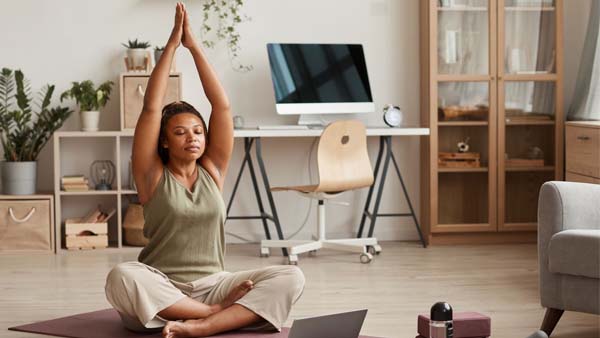
Yoga practice brings together movement, breathing, attention and rest. It does not depend on extreme flexibility or a complicated sequence. A clear foundation begins with familiar poses, steady transitions and enough awareness to recognise when effort has become excessive.
Navigator
Movement with attention
In asana practice, the quality of movement matters more than reaching the deepest version of a pose. Notice where the body is supported, how weight is distributed and whether the transition can be reversed with control.
Natural breathing
Breathing should remain smooth during ordinary poses. When the breath becomes held, noisy or hurried, reduce the range or rest. Structured pranayama can be added later under appropriate guidance.
Five foundations of a steady practice
1. A stable starting position
Begin from a position that can be maintained comfortably. This may be standing, sitting on a folded blanket or sitting on a chair.
2. Clear alignment
Use alignment to organise the pose, not to force every body into one shape. Keep joints supported and make small adjustments rather than sudden corrections.
3. Useful props
Blocks, straps, blankets, bolsters, chairs and walls can make the purpose of a pose easier to understand. Props are part of intelligent practice, not signs of failure.
4. Gradual repetition
Repeat a short sequence until the transitions become familiar. Consistency makes it easier to observe breathing, balance and posture.
5. A quiet finish
End with a resting pose such as Savasana. Allow the breath to return to its ordinary rhythm before leaving the mat.
A simple practice structure
- Two minutes of comfortable sitting or standing.
- Several gentle joint and spinal movements.
- Three to five familiar standing or seated poses.
- A short period of breath awareness.
- Three to five minutes of supported rest.
Common mistakes
- Judging practice by flexibility alone.
- Adding advanced poses before learning stable foundations.
- Holding the breath during effort.
- Skipping props when the floor feels too far away.
- Ending immediately after active movement.
Practice limits
Stop when a pose creates sharp discomfort, dizziness or loss of control. Use smaller ranges and more support when attention or balance becomes uncertain. Learn unfamiliar poses, strong breathing practices and advanced inversions from a qualified yoga teacher.
“Yoga needs no introduction. It is very popular and is performed all over the world. On the other hand, yoga can have different meanings for different people. Some people think of yoga as a form of exercise while others think of yoga as a practice of mental meditation. Yoga, on the other hand, is more than all of this. Yoga, in its most basic form, is about finding meaning in life through reflection. To some, this may seem harsh and insignificant, but in reality, practicing yoga can help you achieve great results as an ordinary person and overcome the difficulties of everyday life.
Fabulous Site!! Lower stress levels lead to improved mental health, more time to relax, and less anxiety. I’m dealing with a lot of issues, including stress, and one of my dear friends suggested that I try gummies. It worked for me, and I saw a big difference.