
Editorial update: This legacy one-legged bridge-pose article has been rewritten as general yoga education with clearer practice limits and safety guidance. It has not been individually medically reviewed. Individual yoga-teacher review remains pending. Read the health-information disclaimer before practising.
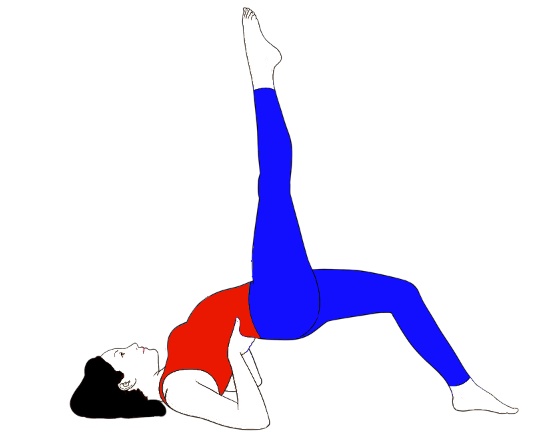
Eka Pada Setu Bandhasana, commonly called One-Legged Bridge Pose, is a progression from Setu Bandhasana. The pelvis is lifted while one foot remains grounded and the other leg is raised. It requires steady hip control and should not be approached by simply lifting a leg as high as possible.
Navigator
Build a Stable Bridge First
Practise ordinary Bridge Pose comfortably before adding the one-leg variation. You should be able to lift and lower the pelvis without knee pain, cramping, breath-holding or a large shift to one side.
Eka Pada Setu Bandhasana Steps
- Lie on the back with both knees bent and feet approximately hip-width apart.
- Place the feet where the knees can track forward without rolling inward or outward.
- Rest the arms beside the body and keep the neck neutral.
- Exhale gently and lift the pelvis into a moderate Bridge Pose.
- Keep both sides of the pelvis level. Shift as little weight as possible before lifting a foot.
- Bring one knee toward the torso while keeping the thigh bent. Pause here.
- Optionally extend the raised leg upward only if the pelvis remains steady and the grounded knee feels comfortable.
- Return the raised foot to the floor before lowering the pelvis.
- Rest, then repeat on the other side.
Supported Modifications
- Practise Bridge Pose with both feet grounded.
- Lift one heel while keeping the toes on the floor instead of lifting the whole leg.
- March slowly by lifting one foot only a few centimetres.
- Place a yoga block under the sacrum for a supported Bridge, but do not perform the active one-leg balance on an unstable prop.
- Reduce the height of the pelvis when the hamstrings cramp or the lower back compresses.
Alignment and Breathing
- Keep the grounded foot fully in contact with the floor.
- Let the grounded knee track in the same general direction as the toes.
- Keep the pelvis level rather than rotating toward the raised leg.
- Use normal breathing without retention.
- Keep the throat relaxed and avoid turning the head while the pelvis is lifted.
Common Mistakes
- Lifting one leg before ordinary Bridge Pose is stable.
- Allowing the grounded knee to collapse inward.
- Twisting or dropping one side of the pelvis.
- Overarching the lower back to raise the pelvis higher.
- Turning the head or placing pressure on the neck.
- Holding through hamstring cramps.
Possible Practice Benefits
The pose may challenge hip control, coordination, back-body strength and awareness of left-right balance. The ordinary two-foot Bridge remains a complete practice option and may be more suitable for many practitioners.
This pose should not be promoted as a treatment for thyroid, reproductive, digestive, spinal or cardiovascular conditions.
Precautions and When to Modify
- Return to two-foot Bridge for pain in the back, pelvis, hip, knee, ankle, shoulder or neck.
- Avoid loading the neck or turning the head while lifted.
- Seek individual guidance after recent spinal, pelvic, hip, knee or abdominal injury or surgery.
- Pregnant practitioners and people with health conditions should use an individually appropriate alternative.
- Stop for dizziness, numbness, sharp pain or symptoms that continue after leaving the pose.
Frequently Asked Questions
Does the raised leg need to be straight?
No. Keeping the knee bent is often easier to control and reduces leverage.
How high should the pelvis lift?
Only as high as you can maintain level hips, comfortable knees and normal breathing.
Can I practise this on a block?
A block can support a passive two-foot Bridge. The active one-leg balance should not be attempted on a prop that feels unstable.
Related SarvYoga Guides
Safety Reference
The National Center for Complementary and Integrative Health advises practising yoga properly with qualified guidance. It also notes that children, pregnant people, older adults and people with health conditions may need individual instruction or modifications. See Yoga: Effectiveness and Safety.
Last editorial update: August 5, 2026. Individual yoga-teacher review remains pending.