
Garudasana, or Eagle Pose, is a standing balance that combines crossed legs with the arm position commonly called Eagle arms. The Sanskrit name refers to Garuda, the powerful bird figure associated with Vishnu in Indian tradition.
The complete wraps are not required. Practitioners can keep the lifted toes on the floor, cross the thighs without hooking the foot, or bring the backs of the hands together. A wall or chair can make the balance steadier while the leg and shoulder actions are learned separately.

Navigator
Preparation
Begin in Tadasana and observe how the feet share weight. Then practise a small Utkatasana to prepare the standing knee and hips.
- Shift weight from one foot to the other without lifting the toes.
- Practise crossing one thigh over the other while holding a chair.
- Circle the shoulders slowly and bend the elbows.
- Cross the arms separately before combining them with the legs.
- Choose a steady point at eye level for the gaze.
Leg Preparation
- Stand with the feet parallel and the knees soft.
- Shift the weight into the left foot.
- Bend both knees as though moving into a small Chair Pose.
- Lift the right foot and cross the right thigh over the left.
- Keep the right toes on the floor beside the left foot for support.
- If balance and knee position remain steady, wrap the right foot behind the left calf.
- Keep the pelvis facing generally forward without forcing exact symmetry.
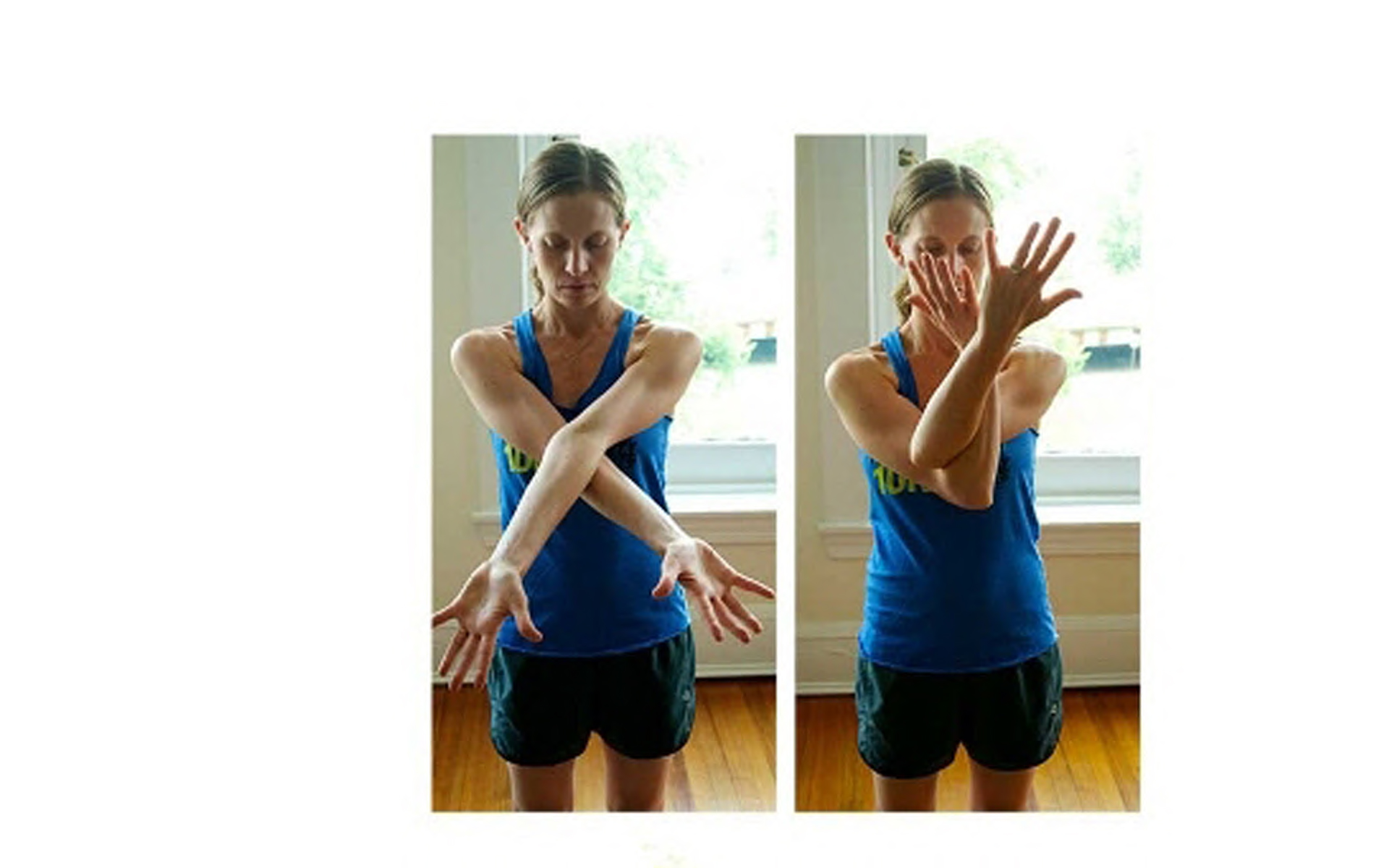
Eagle Arms
- Extend both arms forward at shoulder height.
- Cross the right upper arm over the left.
- Bend the elbows and bring the forearms upright.
- Place the backs of the hands together, or continue until the palms meet.
- Lift the elbows only as high as the shoulders remain relaxed.
- Move the hands slightly away from the face to broaden the upper back.

Garudasana Steps
- Combine the right-thigh-over-left position with the right-arm-over-left position.
- Sit the pelvis slightly back while keeping the standing heel grounded.
- Draw the lower abdomen gently inward and lengthen through the crown of the head.
- Keep the gaze at one unmoving point.
- Take several ordinary breaths.
- Unwrap the arms and legs slowly and return to Tadasana.
- Pause until the weight feels even in both feet.
- Repeat with the left leg and left arm on top.

Supported Variations
- Wall support: stand with one side near a wall and use the fingertips when needed.
- Chair support: hold the back of a chair while practising only the leg crossing.
- Toe support: keep the lifted toes on the floor instead of wrapping the foot.
- Single cross: cross the thighs but let the lower legs remain uncrossed.
- Self-hug arms: hold opposite shoulders when the forearm wrap is not comfortable.
- Seated Eagle arms: study the shoulder position while sitting on a chair.
Balance and Alignment
Spread the toes of the standing foot and keep pressure through the heel, base of the big toe and base of the little toe. Let the standing knee track with the toes. The crossed-leg position may shift the pelvis, so use a small wrap and focus on an upright torso rather than trying to make the hips perfectly square.
Common Mistakes
- Wrapping the lifted foot before the standing leg is stable.
- Letting the standing knee collapse inward.
- Holding the breath while concentrating.
- Forcing the palms together.
- Lifting the elbows so high that the shoulders tighten.
- Looking around during the balance.
- Unwrapping too quickly and losing control of the standing foot.
Practice Effects
Garudasana develops attention to standing balance, crossed-leg organisation and the broadening action of Eagle arms. Practising both sides can reveal differences in balance and shoulder movement. The supported versions preserve these learning points without requiring the complete wraps.
Practice Limits
Release the pose if there is sharp discomfort, unstable pressure, tingling, numbness or loss of balance. Keep the toes down and use a wall or chair whenever the full wrap disturbs the standing knee or ankle. Do not force the foot behind the calf or the palms together.
Frequently Asked Questions
Must the lifted foot hook behind the calf?
No. Keep the toes on the floor or let the foot remain beside the standing leg.
Must the palms touch?
No. The backs of the hands, opposite shoulders or a self-hug are useful alternatives.
How can I improve the balance?
Use one fixed gaze point, keep the standing foot active and practise the leg crossing beside a wall.
your yoga progams are excelent.I am 70 and learnt from doyouyoga.
you should charge bit less from me.I dont want to hurt you since you are my teacher
thank you
Wish you happy prosperous life in your profession.
SHYAM BEHARI SOOD