
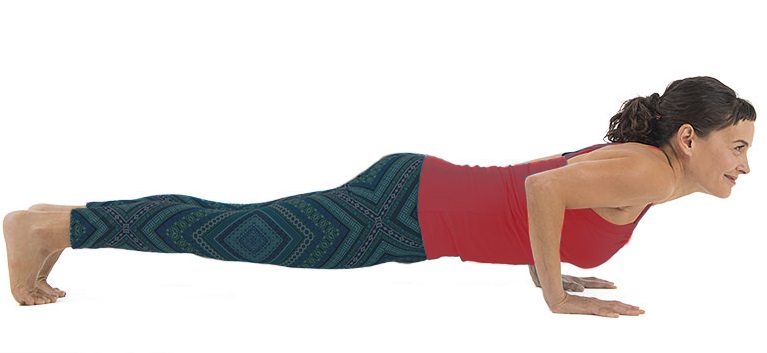
Chaturanga Dandasana, or Four-Limbed Staff Pose, is an arm-support posture commonly used between Plank Pose and a backbend in flowing yoga sequences.
The purpose is not to lower as close to the floor as possible. A smaller lowering range, knees-down version or inclined version can teach the same organisation of the hands, arms, shoulders, trunk and legs.
Navigator
Meaning and Practice Focus
“Chatur” means four, “anga” means limb and “danda” means staff. The four supporting points are the hands and feet in the full variation. The body is organised like a firm staff while the elbows bend close to the sides.
Prepare the Hands, Shoulders and Trunk
- Begin with a comfortable Plank Pose.
- Spread the fingers and press through the full hand.
- Practise Plank with the knees down.
- Keep the shoulder blades supported on the rib cage.
- Place blocks beneath the fronts of the shoulders to limit depth.
Step-by-Step Chaturanga Dandasana
- Begin in Plank Pose with the hands beneath or slightly ahead of the shoulders.
- Shift the chest slightly forward while keeping the trunk long.
- Keep the elbows close to the sides of the body.
- Bend the elbows and lower only as far as control remains clear.
- Keep the shoulders at or above elbow height.
- Maintain one long line through the head, trunk and legs.
- Return to Plank, lower the knees or continue to the next pose with control.
Knees-Down and Block Modifications
- Lower both knees before bending the elbows.
- Place blocks beneath the fronts of the shoulders.
- Practise a small elbow bend from knees-down Plank.
- Use an inclined version with the hands on a wall or sturdy bench.
- Move directly to the floor when the trunk can no longer remain organised.

Shoulder, Elbow and Wrist Alignment
- Keep the elbows pointing generally backward.
- Press the floor away so the chest remains supported.
- Avoid lowering the shoulders beneath the elbows.
- Keep the head aligned with the spine.
- Distribute pressure through the fingers and palms.
- Keep the abdomen and legs active while breathing naturally.
Common Mistakes
- Lowering deeper than the shoulders can control.
- Letting the elbows spread widely.
- Dropping or lifting the pelvis excessively.
- Collapsing between the shoulder blades.
- Placing the hands too far behind the shoulders.
- Repeating the pose after alignment has been lost.
What the Pose Teaches
A well-organised variation can teach hand pressure, elbow direction, shoulder support, trunk stability and controlled movement between yoga poses. A smaller range is often more valuable than a deeper lowering position.
When to Choose a Modification
- Use knees-down practice when the trunk cannot remain level.
- Use blocks when the shoulders lower too far.
- Choose an inclined version when full Plank is not yet stable.
- Reduce repetitions when alignment becomes inconsistent.
- Learn flowing transitions with a qualified yoga teacher.
Frequently Asked Questions
Must the upper arms become parallel to the floor?
No. Stop higher when that is where control remains available.
Is knees-down Chaturanga a complete modification?
Yes. It teaches the same elbow and shoulder organisation with less load.
How many repetitions should I perform?
Use only the number of repetitions that can be completed with consistent alignment and natural breathing.
Related SarvYoga Guides
Practice Summary
Use props, move gradually and keep the breath natural. A supported variation is a complete yoga practice. Learn advanced versions with a qualified yoga teacher.